Raffles at the club – here’s what you should bear in mind
Fundraising
What is allowed, and what do you need to bear in mind?
Raffles are a popular way for many clubs to fund projects or raise money. However, anyone who sells tickets and draws prizes is, from a legal perspective, operating within the realm of what are known as ‘games of chance’ or lotteries. That’s why you should be aware of a few rules.
What is a raffle all about?
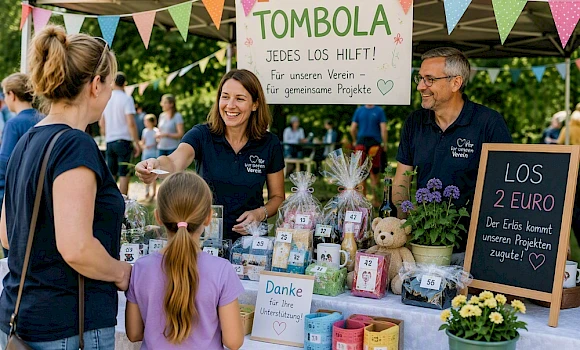
In a raffle, participants buy tickets and stand a chance of winning a prize. Unlike a lottery, the prizes are usually non-cash items rather than cash.
Typical occasions include club parties, anniversaries, charity events or open days.
What are the rules in Rhineland-Palatinate?
In Rhineland-Palatinate, there is a general licence for small lotteries and raffles organised by non-profit, charitable or church-affiliated organisations. This means that a separate licensing procedure is not required for every raffle. One of the requirements is that the net proceeds must be used exclusively for the charitable purpose of the organisation and that certain financial limits must be observed.
The most important requirements include:
- The prize fund (number of tickets × ticket price) must not exceed 40,000 euros.
- The net proceeds must be used for charitable, benevolent or ecclesiastical purposes.
- In principle, the event must not extend beyond the borders of Rhineland-Palatinate.
- There is no obligation to register lotteries and prize draws with a prize fund of up to and including 10,000 euros.
- Minors are not permitted to take part.
You can read the general authorisation and the associated regulations at your leisure in the document issued by the Rhineland-Palatinate Supervisory and Services Directorate (came into force on 1 July 2021, valid until 31 December 2028, accessed on 31 July 2026).
Be careful with children’s raffles. Under gambling regulations, minors are generally not permitted to take part in lotteries or prize draws. This means that a traditional public raffle, where tickets are sold for money in return for a chance to win, cannot simply be opened up to children. Even if parents give their child the money for the ticket, the child would be considered a participant. This is precisely the area where you should be careful.
A practical alternative is to organise activities where every child receives a small prize and there is no actual prize draw with a chance of winning. Such formats can be simpler and better suited to the educational nature of the event, particularly at children’s events.
Model for children’s parties
At children’s parties, different models are often used:
- Parents buy the ticket and formally take part in the raffle.
- Every child receives a small gift, regardless of whether a prize draw takes place.
- There are games in which every child wins and there is no element of chance involved.
- The raffle is expressly offered to adults only.
As the general authorisation in Rhineland-Palatinate expressly refers to the statutory duty to provide information, “in particular the prohibition on the participation of minors”. [add.rlp.de] We therefore recommend consulting the relevant authorities briefly to clarify the legal framework in each individual case.
What practical considerations should your club bear in mind?
Regardless of the size of the raffle, it is advisable to
- number the tickets consecutively,
- to keep a record of the prizes and winning numbers,
- keep a clear record of income and expenditure,
- to publicly state the purpose for which the proceeds will be used,
- and, where possible, to secure non-cash prizes as donations.
The Club Hack: A call to the Public Order Office
So: In Rhineland-Palatinate, there is generally a blanket licence for small lotteries and prize draws organised by charitable organisations. However, even though the blanket licence covers many small raffles, local circumstances or notification requirements may come into play. A quick phone call to the relevant public order office will provide legal certainty. An example:
“We are a non-profit association and would like to hold a small public raffle at a club event, with ticket sales of around €300, to raise funds for children’s art supplies. Do we need to notify the authorities about the raffle, or is the general licence from the state of Rhineland-Palatinate sufficient?”
The call won’t take long and will give you legal certainty. The Federal Ministry for Digital Affairs and State Security has put together a useful online overview (as of 2026).
Raffles held exclusively within the club, in which only club members take part and which are not advertised publicly, may be treated differently under the law from public raffles. In the worst-case scenario, you may not be able to prove this clearly and could find yourself facing legal consequences. We therefore recommend making a quick call to the Public Order Office in this case too.
Useful information to read through
- Rhineland-Palatinate, General licence for small lotteries and prize draws: https://add.rlp.de
- Gambling Regulatory Authority of Rhineland-Palatinate: https://add.rlp.de/themen/kommunales-und-sicherheit/gluecksspielaufsicht
Please note: This article does not constitute legal advice. If in doubt, you should always consult the relevant authority or seek expert advice.